Showing posts with label superheroes. Show all posts

Thursday, June 9, 2016

The Sword of Superman: A Retrospective from someone who was THERE!


Oh the Pre-Crisis era.  For those of you who don’t know, the Pre-Crisis era refers to any event that happened before “Crisis on Infinite Earths”, the first and arguably best revamping of the DC comic book universe.  It was an unprecedented event whose sole purpose was to cut the wheat from the chaff, as it were, and clean up the history of the shared universe that had characters doing all matter of crazy things, sometimes in two places at once.  Basically, continuity was Swiss cheese at the time and nearly impossible to follow.

During the pre-crisis era, Superman had a wealth of wonky powers, some of which made absolutely no sense whatsoever.  One element however sticks out in my mind from way back in the ancient days of 1984.

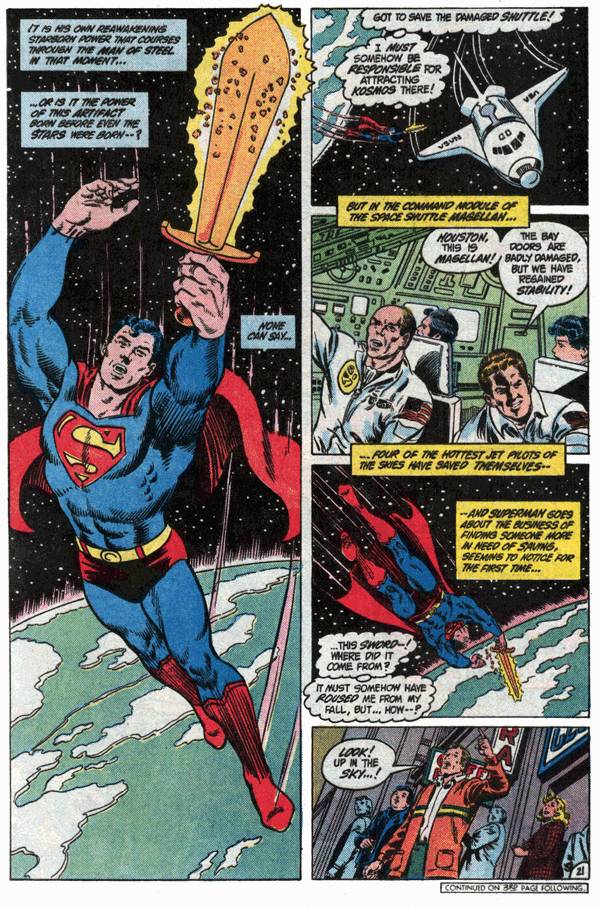
Growing up in Portland, Texas, a sleepy little town on the Gulf Coast, just north of Corpus Christi, comics were not in great supply.  I was five, and if I wanted comics, I had to hitch a ride with my parents whenever they happened to go to Feudos, a neat little market in one of the quiet shopping centers in town.  Feudos had them all…at least to a five year old’s perspective.  Spider-Man and Superman are the ones that stick out in my head.  One specific comic stands out in my memory of this time, and if you haven’t heard of it, don’t feel bad.  It became part of the chaff that was Crisis on Infinite Earths.  It is, of course, the Sword of Superman, ala “Superman Annual 10”.


Now during the pre-crisis era, you would get several explanations for one single event, and the most famously confused event ever was “Why the ‘S’ shield logo?”

Well NOW we all know that it was the family crest for the House of El on Krypton, but back then it apparently had a more significant meaning.
According to the issue, during the Big Bang some primordial matter and energy came together and formed itself into something like an English broadsword.  Because reasons. 


This sword, bearing the “S” shield just existed in history since the dawn of time and when Ma Kent was making Superboy’s first costume, the sword reached out to him telepathically to place the “S” emblem on his suit, apparently because the sword knew he would be important one day.


Later Superman would come into contact with the sword and it would turn him, basically into a god.  I mean more so than he already was.  He became an all knowing, all seeing protector of good, truth, and righteousness.  Think the Infinity Gauntlet, but for good guys.


But there was a price that came with all this power.  The populace he was sworn to protect feared him.  Granted he’s wielding a sword, something that’s generally identified with cutting and stabbing, not something you want to associate with the defender of life.  That’d be like giving Superman a gun…

Yep, that happened too, but that's for a different blog.

So Superman rejected the sword in a sequence of panels that was so weird it may have permanently scarred my young psyche.  Not enough to make me stop reading the comic. I read it till it fell apart, not unlike what happens to the sword!


Spoiler alert, don’t let a pre-teen handle comics without educating him on how to properly care for them in the even they are worth money one day.
So Superman rejected the sword’s power, and it seemed pretty cool with it.  It wasn’t mad at all as it left back into the cosmos and, a year later, was seemingly wiped from history.
But why?  With all the stuff that has trickled through the veil of time over the years, why has Superman’s Sword remained off limits?  Well, at the time it was written out of existence we had Superman and Supergirl, and a slew of super-pets.  That limited who could wield the sword to exactly two people.  Its not like the Infinity Gauntlet or the Cosmic Cube, who could potentially be wielded by anyone.  Its tied directly to two characters and pretty much halts the story all together.  If writers thought it was hard to write around Superman’s powers before, giving him the potential to have infinite power makes it very difficult.
Then there was the growing cast of Team Superman, involving Steel, Superboy, Supergirl, the return of Krypto, and so forth.  Now you could bring in the Sword and let it have some options on which to present that power to, but then how do you get rid of it to let the characters have normal stories again?  It’s been around literally since the dawn of time.  It’s not getting destroyed.  You could put it in the Fortress under lock and key, but then, how can you have cataclysmic events when you could just pull out the sword and fix everything?  How do you justify the Death of Superman if the Sword could have taken care of Doomsday in short order?
I think, personally, from both a nostalgic point of view and from a story telling point of view, you could justify bringing the sword back into continuity.  Tweak it’s origin just a bit, where it became the symbol of Hope on Krypton and later was adopted as the crest for the House of El, and leave it “out there” waiting for Superman to prove himself again.
Just a thought.
Thanks for reading


Tuesday, March 29, 2016

Supergirl + Flash...Dawn of Cuteness?


Alright, so it happened.  I hope to God you guys watched it.  If you haven’t, check out CBS Access or CBS online and see if you can grab it real quick (an hour of your life you won’t regret) and come back because we are going into some serious spoiler territory here.

I don’t often do reviews of stand-alone episodes, but this is different.  This is one of my absolute favorite shows, the Flash, teaming up with the gang from Supergirl.  This episode worked on a lot of different levels.  First of all, if you are like me and only have a tenuous relationship with Supergirl (ie. I’ve watched one, count em one episode so far) this episode served as a great jumping off point as during its events it re-established Supergirl’s premise.  In many ways I came into this show like Barry did.  I’m unfamiliar with the scope of the Supergirl Universe so I really get to know these characters roughly the same time Barry does and he serves as a great entrance point for new watchers.  Like Barry, it doesn’t take the audience long to get up to speed as to who everyone is, at least their fundamental roles on the team.

Secondly, this episode came out less than a week after Batman v Superman: Dawn of Justice broke a few box office records, and before Marvel’s Civil War epic due out later this summer.  That said it actually serves as a big refreshing gulp of wholesome in a sea of hero vs hero media.  Barry and Kara have personalities that naturally click with each other.  Grant and Melissa’s personal and professional history helps in this as well, but ultimately the actors have just this fantastic chemistry with each other and that shines through the whole episode, so much so that I rather wish this had been an hour and a half long episode rather than the standard 48-50 minute running time.  That certainly would have ironed out a few problems.

So what’s the story?  Well roughly around the same time Silver Banshee is coming into her power set and attacking people at CatCo (still sounds like a pet store-terrible name) Kara is knocked unconscious by a sonic blast and hurled out of a window when she is saved by none other than The Flash.  Realizing they both have powers, Barry and Kara get to talking, discovering that Barry has traveled here from Central City, and an entirely different universe.  Barry is looking for what his people call “Earth 2” to have a final face off with a villain named Zoom, but for more of that go see The Flash.  Seriously watch it.

Barry hooks up with Team Supergirl in an effort to find a way back to his universe, but while they are doing that, Silver Banshee springs Livewire from jail.  Both have a hate for Supergirl, and Livewire isn’t too fond of Cat Grant either, so they team up to bring down the cheerleader of steel.  Thinking she only has to contend with Livewire, Supergirl enlists the aid of the Flash (who is more than willing to lend a superfast hand) and they go to face the villain with absolutely no battle plan, despite Barry’s suggestions that they have one ready.  Supergirl is confident that with their combined powers they’ll make short work of the villain and is understandably surprised when Silver Banshee shows up to tip the scales.  Receiving a beat down, Barry suggests a strategic withdraw, and the two regroup to assess the situation.  During this time Kara shares some of her recent personal struggles with Barry who can actually relate to those very specific situations.

Real quick, its important to understand that Supergirl is still in season 1, so the titular character is going through her rookie year while Flash is already well into season 2, so he’s been there and done that, and a testament to Barry’s personality, rather than be jaded by his personal experience, he’s willing to serve as a pseudo mentor to Kara.  He understands exactly what she’s going through, more than anyone else in her world can.  He explains to her that some of the problems she is going to deal with can’t be handled by powers, only time, trial, error, and experience.  He relates to the fact that they are both used to dealing with conflict by falling back on their powers, but that can’t always be the answer.  This exchange, I think was probably the strongest moment in the episode and for both characters.  Barry is finally serving as the mentor figure, when he’s had so many mentors in his time, and he’s learning that when you teach, you learn and when you learn, you also teach.

Kara is receptive to his advice and they soon discover that Livewire and Banshee have kidnapped Kat and taken her to an open park.  There they plan to publically execute her if Supergirl and Flash don’t make an appearance.  During this very brief battle Supergirl puts herself in harm’s way to save a helicopter, while Flash is knocked out on top of a roof (so glad you were here to help buddy).  This turns public opinion, which had waned from Supergirl, back into her favor as the citizens come to her aid and actually defeat the villains for her.

Flash and Supergirl say their goodbyes as they do an impromptu race to get Barry home.  Kara later meets up with James Olsen and finally kisses him, only for him to turn into a brainwashed zombie and wander off with apparently everyone in the city as they are being controlled by Kryptonians.

Let me back up just a bit: James Olsen.  Oh I love what they did with James because he was always the coolest kid in school, and he knew he had Kara’s heart, and never had to work for it, but seemed to keep her at a distance.  When Barry enters the picture and the two instantly click you quickly see James starting to get jealous.  Again, Barry and Kara’s personalities naturally mesh, and they can relate to each other on a lot of levels.  Plus Barry has an impressive skill set to go along with his amazing powers.  He’s super smart and very likable.  Which starts to piss James off, and Mehcad Brooks pulls this off perfectly.

Now let’s look at a few negatives of the episode.  The fights feel very short and anticlimactic, which is why I think this would have been better served as an hour and a half episode.  I say hour and a half, because I think if you pushed this to a two hour episode you would have drawn it out longer than the content would allow.  Giving it an extra thirty minutes however could allow for extended fight scenes and a chance for Supergirl to really earn the city’s trust again.  A lot of that felt very rushed, but it could also indicate that the city wasn’t that mad at her after all.

I’ve heard complaints that it didn’t seem like the Flash had a lot to do here, and he didn’t, but Barry Allen did.  Barry Allen worked with the team to track Livewire, and Barry Allen mentored Kara.  This was really more about characters than it was about spectacle.  Even Winn trying to talk Silver Banshee down, that was more about character development than the actual fight inside CatCo.  Character development is really where Supergirl shines, but it could take a few lessons from the Flash in beefing up its fight scenes a bit.

One of the challenges with any Super(noun) property is that you have to balance the powers with the character and that’s not easy to do on a weekly television budget.  Flash allows a little more room to cheat because you can always have his powers do something without actually needing to show it.  A gust of wind and a sound effect and you’ve planted in your audience that the Flash did something.  Supergirl can actually use this trick too, but I think it doesn’t because that’s a very “Flash” thing.

Kat Grant is still annoying.  I don’t like her, but that’s the character.

So overall, everyone did an amazing job in their roles.  I would love to see Kara show up in Central City, I think that would really shake up some dynamics there.  The fights felt a little neutered, but that’s kind of in keeping with the show.  Hopefully we’ll see more of this kind of cross-company team ups.

Thanks for reading.

Tuesday, July 14, 2015

Legal Advice: The Crimes of The Batman, The Superman, and Lt. James Gordon


There seems to be a skewed image in DC fandom concerning the events of Batman Begins vs. The Man of Steel.  The battle cry is that Batman doesn’t kill, and that Superman could have found a way to stop Zod without killing him.

Let’s take this to the courts:

The charge is homicide, and the definition goeth thusly:

Second degree murder usually applies to cases in which the killing may have been intentional but was not premeditated. These are often referred to as “crimes of passion.” A common example is the jealous husband that flies into a homicidal rage and kills his wife and her lover when he finds them in bed together.

“Some states also consider grossly wanton and reckless behavior that results in the death of another to be second degree murder. This applies in situations where one's actions were so wanton and reckless that the death of another person was almost assured, even if the killing was not intentional.

Second degree murder is also very serious, and in most situations the defendant could face decades to life in prison, though the death sentence is not a possibility in these cases.” (http://www.hg.org/murder.html) 

Does this sound familiar?  In Batman Begins, Ra’s Al Ghul has commandeered a commuter train and is intending to evaporate the city’s water supply and thus spread a fear toxin through the air causing mass panic and death.   Batman’s response to this is to destroy the train before reaching “the central hub”.  He has Lt. James Gordon destroy the supports to the tracks and Batman splits the train in half sending Ra’s Al Ghul and the train plummeting into a parking garage where it explodes, taking the “microwave emitter” with it.

During this event, Batman escapes, leaving Ra’s in the runaway train, stating “I’m not going to kill you, but I don’t have to save you either.”  This is not a morally ambiguous line.  This is a lie Batman has just told himself.  According to the above accepted definition of Second Degree homicide, Batman killed Ra’s Al Ghul.  His actions meet the elements of the crime as defined by Frank Schmallenger’s Criminal Justice Today: 1.  An unlawful killing (Batman has no legal authority to take a human life), 2. Of a human being (Ra’s according to the film was human), 3.  Intent (Batman intended to have Ra’s die in a crash), and 4. With Planning (Batman always has a plan).

Now the question to respond with is “Did Batman have a choice?”  As a matter of fact, he did.  It’s never established that the emergency brake could not be engaged.  It’s never established that the microwave emitter couldn’t be disabled, and despite popular belief, it would be possible to put Ra’s Al Ghul in prison for his crimes.  Even if you consider the “corrupt nature” of Gotham’s police force, they would still take a very dim view of a man trying to annihilate their entire city.  After all, the city he was trying to destroy happens to be the city those “corrupt” officials happen to live in.

Not only did Batman commit Second Degree Murder, he also destroyed any evidence that would corroborate the accusation that the League of Shadows existed or was trying to poison Gotham.  By taking matters into his own hands he actually caused more harm than good.  Further, Lt. Gordon should have been stripped of his office and put into Federal custody for his criminal actions in detonating a high explosive in a urban area causing millions of dollars of damage.

To add to the list of offenses, Batman also committed attempted manslaughter earlier in the film when questioning Dr. Jonathan Crane.  During his assault on Arkham, Batman forcefully exposed Crane to his own fear toxin, the same toxin that threatened to kill the assistant district attorney.  Once Batman realized that the dosage was potentially fatal (never mind that he had already experienced the chemical compound first hand and understood its dangerous, even life threatening effects) he made no attempt to notify medical or legal authorities to have them administer aide to the now poisoned Dr. Crane.  Rather he left him in the Arkham basement to die, driving away now with full knowledge that Crane could, in fact die from the exposure.

But what about Superman?

Let us examine the case against him.  When a small army of super-powered aliens attempted to take over the Earth, Superman extensively worked with the United States armed forces (not just one person) to stop them.  The actions of said super-powered army caused a massive amount of destruction.  Superman, by comparision, caused much less by fighting them.  This was a war-time event.  The aliens were hostile and the military responded as such.  This means that any deaths caused indirectly by the physical confrontation between the aliens and Superman would be considered collateral damage.  Further, had the aliens not attempted to take over Earth, none of these deaths would have occurred.  There is evidence severs the link between Superman and the collateral damage (from a legal standpoint).

But what about Zod?  This is an area referred to as “justifiable homicide”. 

“Justifiable homicide is not murder at all, as it is not considered criminal. Rather, it is the taking of another's life in circumstances in which the killing was necessary as the only means of preventing the murder of one's self or to protect another. Because the killing was justifiable, the person who committed the killing will not be held criminally liable for the death, though civil liability may still exist (i.e. the decedent's family could bring a wrongful death lawsuit).”  (http://www.hg.org/murder.html) 

At the time of the incident there was no means available of effectively subduing or detaining Zod.  The military had already exhausted its attempts to detain Superman earlier, which proved futile.  There was no time or available resources to establish a detainment system to prevent Zod from continuing his rampage (the Phantom Zone generator having been destroyed at this point).  Superman’s attempt to steer Zod away from populated areas was futile as Zod was intent on returning to hot zones in an effort to inflict the most possible damage.  Lastly Zod’s next action would have resulted the immediate death of a family.  Superman’s only recourse to was to end Zod’s life, making it justifiable homicide.  Further, because he was working with an official representative of the United States armed forces with authority to move forward with defensive military actions at the time, this made his actions sanctioned by the military.

Batman, by comparison, coerces James Gordon into becoming an accomplice.  Gordon has no official authority to enlist the aid of Batman.  Batman functions as a vigilante who while sounding cool, is incredibly illegal and Gordon actively harbors him and hinders his apprehension.

Wednesday, May 13, 2015

Superheroes and Faith


In the recently released trailer for Batman v. Superman: Dawn of Justice, there is a brief clip that features a massive statue of Superman with the words “False God” scrawled across his chest.  Now obviously the character of Superman would never present himself as God, or even “a god”, but it does raise an interesting question; how do you handle faith in a world with superheroes?

First, I want to clear up some definitions:  Faith as defined by Merriam-Webster is “strong belief or trust in someone or something: belief in the existence of God: strong religious feelings or beliefs: a system of religious beliefs.”  The Bible defines faith in Hebrews 11:1 “Now faith is the assurance of things hoped for, the conviction of things not seen.”

Yet in, say superhero films, you “see” the amazing all the time.  You see the things that shouldn’t be possible fly all over the world.  How do you deal with a question of faith in a world that has Thor and Loki and the Hulk, in a world that has the King of Atlantis working alongside a man who can run faster than the speed of sound and the last survivors of alien races?

Just yesterday I saw a meme that featured Captain America, pointed out “Met two gods, still a Christian.”  This drew a line of dialog from the Avengers film; where in Captain America was in pursuit of Thor, Loki, and Iron-Man.  Black Widow states “Might want to sit this one out, those guys are basically gods.” To which the Star Spangled hero replies “There’s only one God, ma’am, and I’m pretty sure he doesn’t dress like that.”

When that line was spoken in the film, my wife and I fist pumped and laughed, but now thinking about it, it probably shows the most well rounded opinion of the fantastic things going on, and speaks to just how people of that universe approach faith.

Steve Rogers sees Thor and Loki not as they have been perceived by mythology, but for who they are.  They are another race, another species, and not celestial beings.  He treats aliens and their fantastic abilities and powers no different than he would the Tony Stark, because to him, they really aren’t any different.

It’s a problem we see in our own culture.  We see men and women with amazing talents, namely actors and athletes, and we hold them up on high and attribute to them special qualities, and hold them to a higher moral standard.  When they fail to meet our lofty standards we demonize them.

This is paralleled in the trailer for Batman v. Superman.  Clearly society, or at least a group of society, has lifted Superman above the rest, holding him either to a higher moral standard or even deifying him, and when he either refuses or fails to follow that path, they demonize him, decrying him as “a false god.”

But in Man of Steel, Superman never held himself above other people.  In fact, when faced with a difficult choice, he went to a pastor, he sought out a higher authority, he sought out God, he acted on…faith.

Yet, if you notice, the characters that ultimately lead to questions of faith aren’t technically human.  Thor, Loki, and Superman are all aliens.  Now I’ve heard it said that aliens would invalidate faith by proving that we, humans, are not God’s only creation…but if you go back to the Bible, it’s never stated that Earth was the only thing in the cosmos that God created life on.

Let’s take a look at what the Catholic Church as to say.  I go to them because they are considered the ultimate right-wing, ultimate conservative, ultimate nay-sayers and surely they would be the first to stand up and say aliens aren’t possible because they aren’t mentioned in the Bible…

Well, doing a quick Google search on the topic, you find officials with the Catholic Church; all the way to the Pope himself, when faced with the question “Do you think alien life exists?” shrug and say “Yeah, probably.”

While the Catholic Church could be considered the ultimate “creationists” they also admit that creation is a really big thing.  There is a lot to creation that we are discovering every day.  New species, impossible lifeforms are being found all the time, but that doesn’t make the church rip up Bibles, nor does it make them wave their finger saying “that’s just not real.”

Obviously in the universe contained within the films themselves, they are faced with the irrefutable fact of alien life, main characters are aliens after all, but their existence doesn’t immediately discredit God.

In fact, nothing discredits God.  Even the characters who have amazing powers to traverse impossible distances and venture into the dark unknown admit there is something more powerful out there, something they can’t understand.  It’s why they learn, why they study, because they are still amazed by a greater knowledge yet to be discovered.

So is there a place for Christian faith in, say the Marvel or DC movie universes?  There absolutely is, because even when you have a bunch of answers, they only lead to more questions.

Thanks for reading.

Tuesday, May 12, 2015

Why So Down on Superman?


                I’ve noticed a strong thread in comic book communities that are very pro-Batman, anti-Superman.  Some of this is tongue firmly in cheek good natured ribbing; some of it is down-right hateful.  So I got to thinking, why?  Why are so many people so willing to fly the flag of the Bat and stomp on the S-shield?

I suppose it comes down to a handful of factors:

1)      Superman is easier to pick apart.  Not only is he generally accepted as the first superhero, he is implausibility incarnate.  You can try to science your way around his powers, but when you step back and look at them, they are a ridiculous combination of plot conveniences smashed together and wrapped in blue tights. 


Batman, on the other hand, has no powers, and we are psychologically predisposed to relate to him because he’s “human”.  He is stupid rich, has an unlimited supply of improbable technology, a massive underground lair full of the craziest stuff you could put together, but it rolls back to him being human.  We may never be ludicrously wealthy, have a fleet of jet black vehicles and our own personal football stadium to park them in, but we can dream, and just being human we are part of the way there.


2)      Batman is the bad-boy.  I’ve heard it said, Batman is the one girls want to date, Superman is who women want to marry.  This stems from Batman’s tortured past and dark persona.  Girls tend to lean towards men they can mold, shape into someone better.  Superman is that better person.  He’s honest, kind, noble, heroic, and never sticks around for praise.  Batman is menacing, brooding, and more likely to beat the crap out of the guy who gooses you in a bar. Superman represents a level of stability that’s appealing to women looking to set down roots but still want the occasional adventure.  Batman, on the other hand, will globe trot at the drop of a hat and his life is constantly popping. 


3)      We want to be better than Superman.  Ever noticed how everyone can come up with a thousand ways Batman can beat Superman.  Some folks can rattle them off the top of their head.  Some of these are severely sinister plots that require hours of intense thought.  This stems from our “mortal” insecurity.  We want to think that if push came to shove, we could bring down the Man of Steel because he makes us feel inadequate.  “Because I’m Batman…” isn’t just a clever punchline, it’s a catch all to make us all feel better than Superman.  What makes matters worse, at least for John Q. Human, is that Superman never boasts about his powers.  He’s calm and quietly awesome without effort.  Batman has to “work” for everything.


What is kind of sad is when you try to counter the argument of “Batman can beat Superman…” by saying “But Superman can…” “NO, Batman already won.” “Yeah, but if Superman just…” “BATMAN’S AWESOME SUPERMAN SUCKS!!!” (Actual conversation)  Some refuse to believe that Superman could be anything more than Batman’s bitch.  (By the way, hurricane force super breath invalidates like 99% of what Batman can do.)


What the whole debate actually boils down to: who is writing the story?  Guys like Frank Miller will always have Batman win because Batman.  Other writers will side with Superman and the fight will be over before it gets started.  Looking at Dawn of Justice trailer, I was thinking

“Do you bleed?  You w…” and Superman blows Batman into the next county with just a quick puff of breath.

But I may just be saying that because I love Superman.

Later!

Thursday, May 7, 2015

Gotham: Series Overview


Well, it was only a matter of time before I talked about this series.  I was going to get to it, but I don’t like doing episode by episode reviews, I tried that a while back with Once Upon a Time season 2, and it didn’t work within my schedule.  So, rather than try to tackle this show one piece at a time, let’s look at it one character at a time and see how they’ve grown over the course of the series.

The overall plot of Gotham is to follow the adventures of the last good cop in the city, Detective Jim Gordon, played by Ben McKenzie.  Former military, Gordon approaches his police work with a single minded focus on the traditional model of law enforcement; police should be pillars of the community, an example for the public to aspire to, and to have the protection of the public be their number one goal.  This mindset clashes heavily with his fellow officers who are caricatures of corruption.  Notably his partner, Harvey Bullock and Captain Sarah Essen seem beaten down by the corruption in the city, until Gordon’s example lifts them out of their funk.  Still fearful of the hostile environment, rather than slam head log into their opposition, they use the twisted system to engineer justice in a place where justice was a fantasy.

This doesn’t mean that everyone loves Gordon.  They like his results, most of the time.  As he attacks each case, he rubs people the wrong way, and they are numb, if not outright hostile towards him.  When he collars the perpetrator, however, or saves the city from this-that-or-the other, they salute him and treat him as a hero.

What is ironic is that while Gordon is arguably the most interesting character in the show, he’s also the least interesting of the show.  I say that because you know how he’s going to act.  We’ve seen his phases when dealing with relationships, cases, co-workers, and outright villains.  He’s got to be the most interesting portrayal of the character because he’s very competent in his job, unlike say some movie versions, and has taken down at least two major villains on his own, most notably the Electrocutioner.

He’s shown he can do his job without the aid of a lunatic dressed as a bat.

Speaking of which, we also have David Mazouz as young Bruce Wayne, and not far behind him Sean Pertwee as Alfred.  I link these two characters because this is the time in Bruce’s life when Alfred is his guardian and Alfred takes that responsibility to heart, even going super soldier mode when assassins target Bruce and Selena Kyle (more on her in a minute).  Sean Pertwee’s take on Alfred is absolutely fantastic.  He rides the fine line between parent and servant to Bruce Wayne.  I’ve read it in comics where Bruce and Alfred’s relationship was described as Bruce values Alfred, seeing him as the only family he has, but also its very clear Alfred works for Bruce and, more often than not is subject to Bruce’s orders and whims, whether he agrees with them or not.  That’s very well portrayed in this show, as Alfred offers council, advice, and training as requested, and will even voice his concerns, but will do whatever it takes to see his employer’s requests are met.  Alfred loves Bruce and will kill to protect him.

Bruce’s side of the relationship is complex as well.  The series picks up almost at the moment of the Wayne’s murder, so we are thrust right into Bruce’s life scarring event.  I don’t think I’m out of line saying that Bruce is suffering from PTSD, and the combination of the writing and Mazouz’s performance really bring out the more subtle accents of the disorder.  Bruce is seen suffering from nightmare, obsessing over various topics, self-destructive activities, and a lot of unfocused aggression.

It’s made clear that Bruce is seeking something to fill the void left by his parents’ murder.  He becomes an amateur detective in an attempt to find meaning behind their deaths, thus holding on to the last shreds of his parents.  He also looks to Alfred as a father figure, but at the same time maintains their traditional employer/employee relationship, so no matter how close they grow, there will forever be a distance.  Basically Bruce could really use some counseling…

Unfortunately as we find out in the season finale, Dr. Leslie Tompkins has limited crisis counseling experience.  Otherwise she could have, and probably should have, filled her comic book counterpart’s role as counselor to the young Bruce Wayne.  Instead she starts out as a staff physician at the newly re-opened Arkham Asylum, and later takes over as the medical examiner and Jim Gordon’s love interest.  When she first appeared in Arkham, I was hopeful because Morena Baccarin has a very soothing on screen appearance and could easily portray a counselor.  I honestly thought that was the role she was going to fill.  Baccarin does a wonderful job in the role anyway, but I think the character could have been taken a different direction.  Yet it’s entirely possible that Tompkins will take on the crisis counselor role later after experiencing the trauma of facing off with a crazed Barbra Kean.

Comics are, in general a twisted knot of ret-cons, with multiple writers trying to put their own mark on the history of iconic characters.  No set of characters suffer more from this than Jim Gordon’s immediate family.  It is a mess and I’m not even going to try to compare the comic version to what we see in Jim Gordon in Gotham.  That said Barbara Kean was Gordon’s first girlfriend in the series before she left after Gordon had run afoul of Police Commissioner Loeb.  When she returned after his reinstatement, he had already moved on to Leslie Tompkins and Barbara sent herself on a self-destructive spiral that culminated in her encountering the serial killer known as “The Ogre”, her murdering her parents on his orders and eventually trying to kill Tompkins, only to be stopped by her ex-boyfriend.  Everything I just said there, that’s simple compared to the comic book counterpart.  Erin Richards plays the role well enough, I never really liked the character, but I don’t think we were ever meant to like her.  Richards plays the transition from emotionally wounded socialite to full on psychopath with a great deal of believability, and I look forward to what direction they take the character post-psychotic break.

Edward Nygma is the next character that is worth talking about because he himself as a very interesting transition.  Nygma is set up as the GCPD’s forensic expert who likes riddles.  He really likes riddles.  He likes them so much he tries to bring his information to the officers investigating the case in the form of a riddle, much to their annoyance.  His relationship to Gordon is interesting because he seems to almost admire Gordon.  Gordon was, apparently, the first detective he’s worked with to rattle off the answer to a riddle right away.  Played by Cory Michael Smith, he’s shown to have more than a few sociopathic personality traits, tries unsuccessfully to woo the affections of records specialist Kristin Kringle, and later murders and brutally disposes of the body of her lover.  His first foray into his comic book counterpart’s psychosis is when he forges a letter from the deceased boyfriend, but arranges the sentences so that the first letter of each line spells out “NYGMA”.  He has a psychotic break later, berating himself for leaving an obvious clue.  It’s hard to gauge where this character will go next.  My guess is that he’ll continue to work with the police, only to watch as they try to decipher the clues from the crimes he commits.  This actually plays well into the character from the comics as he always held himself intellectually superior to those around him and it seems logical he would place himself in a location where he can watch people run themselves ragged trying to decipher his clues.

However there are wasted and unnecessary characters as well.  Part of the problem with most American television programs are filler episodes.  These are episodes that provide no information towards the overall arc of the season, only put there to fill an episode quota and provide a “villain of the week”.  Smallville was notorious for this, but I’ll get to them later.

Gotham doesn’t necessarily have any “filler episodes” per say.  Everything is designed to reveal or, sometimes, force feed us characterization, letting us get into the mind of the characters.  If the A-plot doesn’t cover something significant for the overall story, then the B-plot usually adds something, usually by establishing relationship ties.

Ivy Pepper, our proto Poison Ivy for the show, is a unnecessary character.  They literally could have written her out of the entire show at this point and not missed anything.  Midway through the series they introduce a character named Jerome, who again, has no business in the show other than to tease us with a possible Joker origin.  I’ve read that there will be more Joker build ups later, but that’s to come.

Finally under the tent of unnecessary is Attorney Harvey Dent.  He’s set up as a young, up and coming lawyer, with possible dissociative identity disorder, show when he rages at a suspect, and then is promptly dropped.  He’s depicted as a contemporary of Jim Gordon, which is sometimes comic book accurate.  What isn’t comic book accurate is how Dent later becomes Two-Face in the comics, in which his face is scarred by acid thrown by gangster Sal Maroni…

Which brings me to wasted characters, the top of which is Sal Maroni, who is played by David Zayas.  Zayas’ had a spot on portrayal of this rough and uncouth mobster, reminding me of DeNiero as Al Capone from The Untouchables.  If you took Carmine Falcone (John Doman) to be Don Vito Corleone, ala The Godfather, then the pairing of these two legendary mobsters was a fantastic example of two-sides of the same coin.  Which was ruined by Fish Mooney.  Not to knock Jada Pinket-Smith’s portrayal, she actually reminded me of Eartha Kit from time to time, but the inclusion of Fish Mooney was just not necessary, at least not in the capacity in which she was shown.  They could have set her up as a rival crime lord, not an Falcone lieutenant with high aspirations, and they could have focused on her conflict with them more than the Dollmaker plot thread.  That felt forced and actually plugged in some sub-par computer generated effects, which we could have been sparred if they had gone a different direction.

Finally, there is the Penguin, played by Robin Lord Taylor.  I really don’t know what to say about him.  I can’t give him too much praise as I feel he did what was expected of him, and I can’t knock him because he did his job well.  He made you watch him every time he was on screen, but I didn’t love the character.  He was dangerous, but that danger wasn’t out of left field, you always knew it was there.  I think, he’s kind of an anti-Gordon.  His arc is predictable, but well portrayed. 

I suppose I should talk about Selina Kyle, played by Camren Bicondova.  Again, she did a good job, but she didn’t have the same caliber of material Mazouz did.  She wasn’t anything we haven’t already seen before, but that’s not the actress’s fault.  People have been doing their spin on the orphan thief with questionable ethics for generations, so the odds were against her.  She had a good, if subdued screen presence, with a dangerous-bad girl vibe.  She ended the season showing Selina had a violent streak in her, so it might be interesting to see where they take it from there.

Overall, it’s a pretty good prequel series, easily in my top 10, but maybe not directly in my top 5.  Give it a watch and see for yourself.

Monday, May 4, 2015

Suspension of Disbelief

Sometimes I feel the need to justify why I talk about certain topics.  Well, today is another day.  You may have noticed that I've spoken frequently about a lot of television and movies, but not so much about the average novel.  That's because I'm addressing popular, mass consumed media.  People, I'm noticing, don't have much time for books anymore.  This is depressing, mainly because one day I hope to publish a novel of my own, but I also completely understand why.  After becoming a parent I found myself with precious little time to read anything that didn't have hard-cardboard pages or wasn't a book made entirely out of fabric.  I sincerely don't think anyone wants me giving a critique on "Hop on Pop" any time soon.  If you do, you may want to re-evaluate your priorities.

As it is, the times when I do have an opportunity to read, well, anything, is when I am out of town for a work trip, which admittedly isn't that often.  So, I watch a lot more than I read, and I've watched a lot.  A lot of television, a lot of web reviews, a lot of short comedy videos and a lot of major studio movies.

In doing so, I've also nitpicked a lot of little issues.  I've watched procedural cop shows like "Blue Bloods", "CSI", and "Castle".  Working in law enforcement I've openly balked at how little procedure is followed in procedural cop shows.  Either they've gotten so out of the realm of possibility with their forensic science that it might as well be science fiction, or their procedures are so poorly adhered to that they should have a conviction rate of approximately 0%.  These issues, however, can fall under the category "creative license", or as I've come to understand it "rushed research".

Three factors plague the cop show.  1) Studio expectations:  The studio needs the production company to bang out a product in as short as time possible.  That said, writers can't spend a lot of their time looking up laws and studying criminal justice text books to get every aspect right.  "Law and Order" has had to take short cuts and they are considered the high mark of the procedural show.  "CSI" in it's various incarnations has to talk about forensic science, but the writers aren't forensic scientists themselves.  They are paid writers and as such have to focus on telling a good story without bogging the audience down in the science.  Which leads to the next problem:

2) Assumed education level of the audience: The writers can't know if the person watching their show at home has an associates in criminal law, heck most people working the rank and file of civilian jobs in law enforcement don't have an associates in criminal law.  They need to write to the lowest common denominator, and so throw in some techno jargon, flash some stuff over a computer screen, call it science and move on with their story.  The science is a tool within the story, but not the story itself.  They can't let the science or the procedure out shine the story and tone of the work.  This brings us to:

3) The tone of the piece:  I don't think anyone looking is looking to "Castle" for hard hitting crime drama, that's not the tone of the show.  The show is lighter, happier, and more hopeful than say "Law and Order".  Actions don't necessarily have consequences that carry over into the next episode.  Much like Kenny from the early days of "South Park", next episode we will be back to status quo.  In that regards, the show feels more like a cartoon than anything else.  The line "We'll send it to tech for clean up..." sounds a lot more fun than "That's the best resolution we can get because of the pixel ratio and the software that powers the camera itself."

Having reality interrupt your escapist fiction is jarring, especially if it doesn't fit in the tone of the piece.  You watch the news or documentaries for reality, everything else is to escape from that reality, with varying levels of departure.

Its no secret, I love Superman.  My sister professes that I've loved the character since before I was born, which is entirely possible I guess.  Some years ago, around the time "Superman Returns" came around, the History Channel presented a piece called "The Science of Superman".  I watched it, and I kept coming back around to one simple response to every complaint they had about Superman's impossible powers..."Its not suppose to be real.  Its a comic book."  They were trying to invade Superman's world with reality, and there's really no place for it.  It doesn't fit, and no amount of hammering will make it fit.

However, as I said earlier, there are various levels of departure from reality.  A good measuring stick for this would be the Batman film franchise.  In Tim Burton's "Batman" from 1989, it clearly took place in it's own world, like it was lifted from the pages of a 1940's comic book.  Stepping into that world, you could believe everything they told you, because nothing stood out as weird.  As the movies progressed, the world got weirder and weirder, and regardless of how you actually felt about the movies themselves, you can honestly say that each Batman belonged in that world.  Then you move to Christopher Nolan's Batman.

Nolan and his team sought to ground Batman in something resembling reality.  The world was gritty, but not overly so.  There was both hope and hopelessness and our hero stumbled and fell along his journey as we all do.  Yet nothing about Batman himself stood out in "Batman Begins".  He fit into his reality, and we weren't prone to question it since that reality felt a lot like our own.  "The Dark Knight" came around and, again, it felt close enough to our world that we didn't waste any part of the movie questioning it.  But "The Dark Knight Rises" had the dubious task of upping the ante and bringing the overall story full circle.  The problem is that reality doesn't up the ante, so much as it just pushes on and we react accordingly.  The world of Nolan's Batman felt so close to ours that our suspension of disbelief wasn't really being used, so when Batman travels halfway around the world into a no-mans land without any conceivable means of conveyance, and accomplished this journey in what seems like a day, we are suddenly jarred.  Then he seemingly survives a nuclear blast.  Suddenly we have to suspend a lot of disbelief, the distance between our world and the fantasy world has grown to huge lengths with no time to adjust.

That's like having a transformer show up in a Tyler Perry movie.  It has no place and our brains aren't ready for it.

The only thing I can think of that Nolan and his team could have used as a bench mark to justify this is a line from an interview with Stephen Speilberg when he was talking about "Jaws".  Spoiler alert if you haven't seen this classic.  At the climax of the film, the main character shoots an air tank lodged in the shark's mouth and it explodes half the shark.  Speilberg knew this wasn't accurate, and his team knew it.  When they talked to him about it he addressed the suspension of disbelief as such "If I've had them for this long, at this point in the movie, they'll believe anything I tell them."

This, isn't wrong.  But if that was the bench mark, then Nolan and company forgot that prior to the shark blowing up, we were treated to other physical improbabilities, like a giant great white shark, said shark being strong enough to drag barrels below the surface, its ability to pull a very large boat, and destroy a bigger boat with it's shear bodily force.  Physics took a back seat to story and that's fine, because it all fit together.  We didn't have to suddenly suspend our disbelief for the air tank because it was already suspended for the rest of the movie.

The Nolan-Batman films, however threw us super-speed Batman who can walk on water while sauntering away from a nuclear explosion without giving us anything to build on.  Yeah, its a billionaire who dresses as a bat, but they worked so hard to make it make sense.  They put it all in context and then threw it out the window.

Now, when I say I don't read a lot, it doesn't mean "I don't read."  I do.  I'm currently reading a book by my best friend, "Under the Undead Moon" by William Dilbeck.  As you may have guessed, I can be very critical, especially when I believe people could do better.  That said, there is some police procedure that my friend gets wrong, but I honestly let it slide, because its a supernatural horror story.  I can't really nit pick that someone's Miranda warning wasn't read when they were fighting zombies a few pages earlier.  Actually I could, but I won't because it doesn't violate the tone of the book.  It wouldn't be fair because when you put it into context, its not wrong.

We can be hyper critical, but if there has been one thing I have learned from my kids, its that you will never enjoy a story if you spend all your time standing outside it picking at it.

At the same time, a suspension of disbelief, or as I said in "Batman Begins" a lack there of, can sometimes hinder further story ideas.

Some time ago, I was discussing with a college about the idea of a "Justice League" story, ala Marvel "The Avengers" film franchise, where they could tie it into the Christopher Nolan Batman films.  Looking at it now, I can say it would not have worked.  You could not have connected "Superman Returns" to "Batman Begins" to "Green Lantern", because all three worlds felt so different in the films.  Regardless of what you say about Marvel's franchise, they balance out comic book silly with epic film making.  "Superman Returns" could have connected to "Green Lantern", but they could not link up with the final installment of the Batman trilogy because of one character, Bane.

Bane, in the comics, is a super villain who takes a super steroid called "Venom" to grow massive and become super strong.  In the film "The Dark Knight Rises", he's a man in exceptional shape who's body is so wracked with injuries he needs a mask constantly pumping anesthetic into his system to stave off crippling agony.  His presence in the franchise serves as a blockade of disbelief.  If you have a universe where Superman and Green Lantern exist, then why can't Bane use his venom drug?

Now, for me at least, all of these movies work on their own.  I can enjoy "Superman Returns" and "The Dark Knight Rises" equally, but that's because their set up requires a unique suspension of disbelief, I don't have to ask a bunch of questions to make it make sense.  Put them together, and you open a lot of plot holes.  The reason you spot plot holes after repeated viewings sis because you are initially immersed in that world.  Its not until  your second or third time in that "pool" that you start to notice it.

That's why I'm actually grateful for the new stories coming out with "Man of Steel" and "Batman v. Superman" (though the latter sounds like a court case) leading into their Justice League story...they are establishing a new world where possibilities are open for story telling.  Will I nit pick?  Probably, but at least I will do it later rather than during the films.

Remember, when it comes to your escapist fiction: Go big, or go home.

Later.

Friday, February 13, 2015

The Crow vs Hollywood


If you are a fan of superhero movies, action movies, or revenge movies, you probably remember the 1994 (twenty-one years!) film starring Brandon Lee entitled “The Crow”.  For those of you who don’t remember, this featured Lee as musician Eric Draven.  Late one evening Mr. Draven and his fiancĂ© are terrorized and ultimately murdered by a gang.  One year later, Draven returns from the grave, summoned by the titular bird, and exact bloody revenge for the crimes that went unpunished.  There is also a fight scene on top of a roof and a pseudo psychic lady.  And Tony Todd is there to, basically being Tony Todd.  It was the 1990’s.

So why do I bring it up now?  Well, the movie spawned a handful of sequels, most of which went straight to video, and one mediocre TV series.  Now, the problem with all of the sequels was that it tried to copy the original, as sequels often do.  You see, there is a common phenomenon when it comes to Hollywood where in when a movies does particularly well at the box office, the studios will immediately try to capitalize on it’s popularity by producing a film nearly identical in story structure with half the budget and none of the returning actors.  This is called cashing in or riding coattails.

What made the original film original was the same thing that made the following sequels terrible.  A good movie, I mean a really good movie, is like a lightning strike.  Its bright, its powerful, and it leaves an impression on everyone who witnessed it.  Sequels are kind of like getting a spot light and shining it in people’s faces and claiming it’s just as good as the original strike, even though everyone present knows full and well it’s not even close.

Back in 1990’s, and still today but especially back then, movie studios didn’t really care about how good the sequel was.  They relied strictly on name brand to carry their product and sat back waiting to count money.  Now what is inexplicable to me is how a studio can crank out a subpar follow up film (in the case of The Crow it was “The Crow: City of Angels”) which makes less money than the original and fans decry as being an inferior film, only to follow it up with progressively worse movies (The Crow: Salvation and The Crow: Wicked Prayer).  These films follow the exact same formula but consistently fail to capture the magic of the original.

The Crow got a decent follow up in the form of the Canadian TV series entitled “The Crow: Stairway to Heaven” which followed the original Crow, Eric Draven now played by Marc Dacascos.  This time, however instead of returning to the grave after his quest is completed, Draven continues to roam the earth fighting evil.  Why did this work when others didn’t?  Well, while fans of the original admitted that it was not the same caliber of the original, they had to admit that it respected the source material and actually tried to spin original stories.  In short, it didn’t do a straight up copy of the original.  It tried to be its own story.

That is where the studios failed.  When CoA failed to perform in the box office, they should have backed up and focused on telling a new, better story.  Not the same story, only with less budget. 

Modern sequels of popular movies have seemed to learn this lesson.  When follow ups to 1989’s “Batman” failed in the forms of “Batman Forever” and “Batman and Robin” Warner Brothers understood where they went wrong.  When “Batman Begins” rebooted the franchise, the follow up “The Dark Knight” was widely credited as being a much better film than the its predecessor.  The same thing happened with Iron-Man 2 and Captain America: the Winter Soldier.  They succeeded because they were going to tell new stories, explore new avenues of the narrative.  Spider-Man 2 was better than Spider-Man (Sam Rami series).  Iron-Man 3 was better than Iron-Man 2.  We’re moving, generally in the right direction with sequels, we’re continuing the story rather than rehashing the old one or telling a sub-par narrative with flashy lights to distract the audience. 

Now as I am typing this, they are working on a reboot of the franchise.  What is actually encouraging is that right now they are on the fourth or fifth attempt at rebooting it, which means they have time to get it right.  Does it mean they will use that time wisely, that’s debatable.